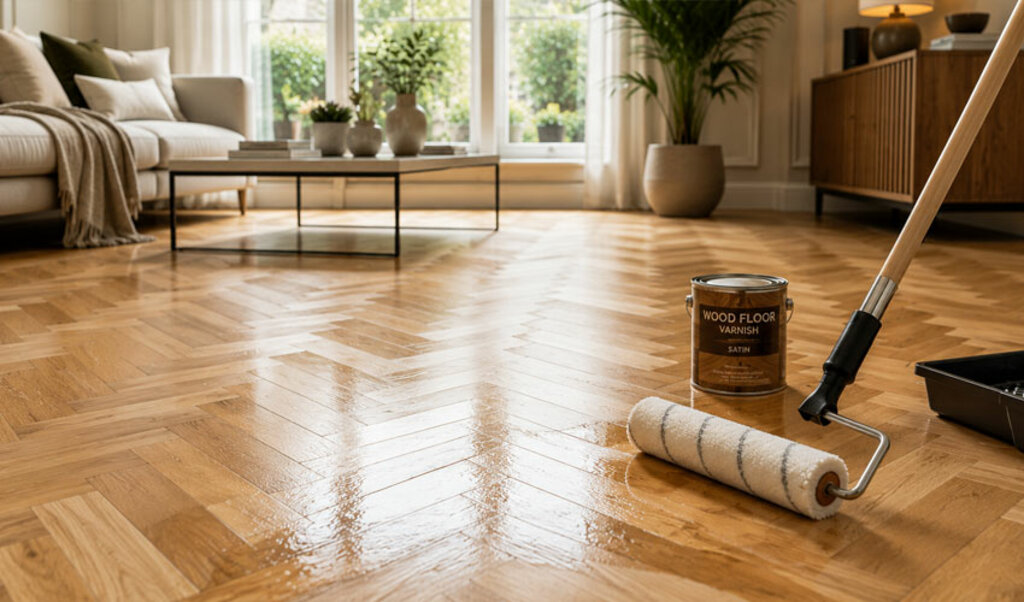
Parquet floors, whether in traditional herringbone block format or in more contemporary plank herringbone or chevron layouts, present specific challenges in floor finishing. The alternating grain directions of the blocks mean that sanding and varnish application need to be approached differently from straight-run plank floors. Getting this right produces a floor that looks even and professional; getting it wrong produces a floor with visible machine marks or uneven sheen.
Sanding Parquet: The Challenge of Grain Direction
In a standard herringbone parquet layout, adjacent blocks are laid at 90 degrees to each other. This means that sanding along the grain of one row of blocks produces cross-grain sanding on the adjacent row. True with-grain sanding in both directions simultaneously is impossible on a herringbone pattern.
The standard approach for sanding herringbone parquet is to sand diagonally, at 45 degrees to both block directions. This produces a 45-degree angle sanding direction on every block, which, while not ideal for any individual block, is equally consistent across the entire floor. Starting with 40-grit diagonally and progressing to 60-grit and 80-grit at the same angle, then finishing with an 80-grit or 100-grit orbital or vibrating sander across the whole floor, produces a good surface ready for varnishing. Our sanding abrasives range covers this full grit progression, in both discs and belts depending on your machine.
The final orbital sanding pass is important for parquet. It removes the slight grain-raising that can occur from the diagonal sanding direction and produces a surface that is consistent across both block orientations. This final pass should be done in two or three directions to ensure complete coverage.
Varnish Application on Parquet
Varnish application on parquet follows the same principles as on plank floors, but with one additional consideration: the seal coat application direction. Apply the seal coat across the diagonal of the herringbone pattern, which ensures that the product is worked into the grain of every block rather than gliding over the cross-grain blocks on alternate rows.
For the main varnish coats, applying along the full length of the room (which will be at a diagonal to the herringbone pattern) and maintaining a wet edge across the room area works well. Work with the length of the room rather than trying to follow the block pattern.
Between coats, screen the floor with 100-grit to 120-grit screen to remove grain raising and ensure good intercoat adhesion. This is the same process as for plank floors, and it is equally important on parquet.
Product Selection for Parquet
Bona Traffic HD is widely used on parquet floors and produces excellent results. Its extra-matt formulation is particularly popular on old oak parquet blocks where a very natural look is desired. For solid oak parquet that will be sanded and refinished periodically over many years, a quality two-component varnish such as Traffic HD provides strong durability per refinishing cycle — worth weighing against a standard one-component lacquer if the floor sees regular, heavy use between refinishes.
Hardwax Oil as an Alternative to Varnish
Varnish isn't the only route for parquet — a hardwax oil finish is a genuine alternative worth considering, particularly on reclaimed or character-grade parquet where the goal is to keep the floor looking and feeling like natural wood rather than sealed under a film. Unlike varnish, hardwax oil soaks into the grain, and small marks can often be spot-repaired locally rather than needing the whole floor resanded. The trade-off is a softer, less uniformly wipe-clean surface than a lacquered floor — worth thinking about for a hallway or busy room versus a lower-traffic space. Coloured hardwax oils are also available if you want to shift the tone of old, mismatched parquet blocks toward a more consistent finish without a separate staining step.
Summary
- Sand herringbone parquet diagonally at 45 degrees to both block directions
- Finish with orbital sanding in multiple directions to remove machine marks
- Apply seal coat along the diagonal of the pattern
- Apply varnish coats along the room length, maintaining a wet edge
- Screen between every coat
- Bona Traffic HD extra-matt is a strong choice for traditional oak parquet; hardwax oil is a genuine alternative where a more natural feel is wanted
The patience required to prepare and varnish a parquet floor properly is repaid by a result that is beautiful and durable. Old parquet floors that have been poorly maintained or covered with carpet for decades can often be completely transformed by a professional sand and varnish, revealing extraordinary quality beneath the surface neglect.
Common Questions About Varnishing Parquet Floors
Why can't I sand parquet the same way as a plank floor?
Herringbone parquet has blocks laid at 90 degrees to each other, so sanding with the grain on one row means sanding across the grain on the next. Diagonal sanding at 45 degrees gives a consistent result across every block, rather than favouring one direction over another.
Should I varnish or oil my parquet floor?
Varnish gives a sealed, wipe-clean surface with strong durability, particularly with a two-component product like Bona Traffic HD. Hardwax oil keeps a more natural look and feel, and allows local spot repairs, but doesn't form the same sealed surface film — the right choice depends on the floor's traffic level and the look you want.
Do I need to screen between every coat of varnish?
Yes — screening with a 100-120 grit screen between coats removes grain raising and helps the next coat bond properly, on both parquet and plank floors.