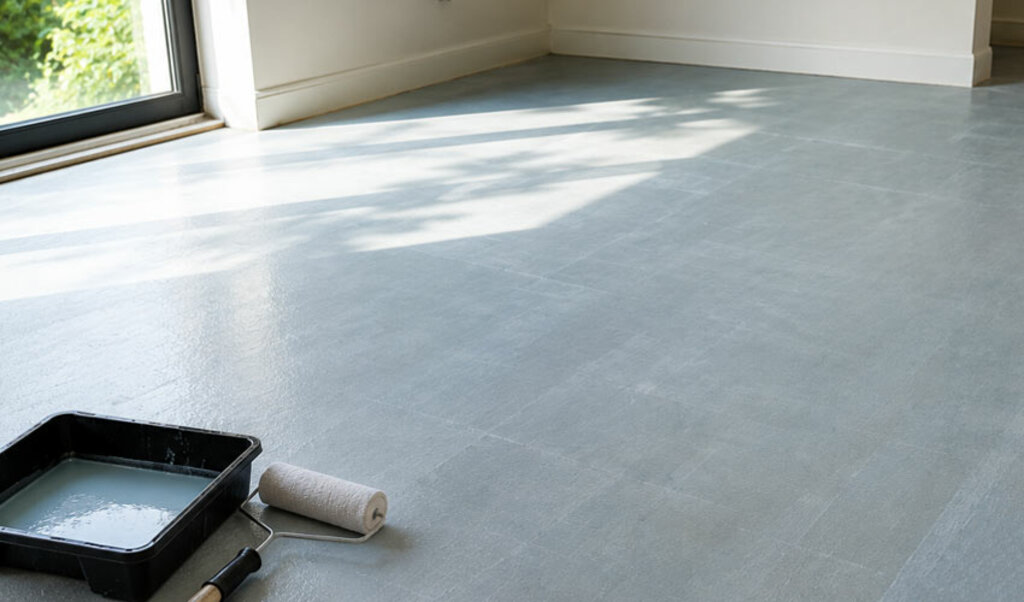
Moisture rising through a subfloor is one of the most common — and most avoidable — causes of a wood or laminate floor failing after installation. Unlike a leak or a spill, subfloor moisture isn't always obvious; a concrete slab can look and feel perfectly dry while still releasing enough moisture to cause real problems underneath a newly laid floor. This guide covers what a damp proof membrane (DPM) primer actually does, when you need one, and which of our products fits your situation.
Why Subfloor Moisture Matters for Wood and Laminate
Wood-based flooring absorbs moisture from whatever it's sitting on, not just the room's air. A new concrete slab can continue releasing moisture for months or even years after it's poured, and older concrete can still carry rising damp from the ground beneath it. If that moisture reaches the underside of your flooring, it can cause boards to swell, cup, or delaminate — problems that show up after the floor is down and in use, when they're far more disruptive and expensive to fix than they would have been to prevent.
What a DPM Primer Actually Does
A damp proof membrane primer is applied directly to the subfloor before flooring goes down, forming a barrier that blocks moisture from migrating upward into the new floor. This is a different job from a standard bonding primer, which just improves adhesion — a genuine DPM primer specifically has to demonstrate moisture-blocking performance, usually expressed as a maximum residual moisture percentage it's rated to handle.
DPM Primer Options We Stock
Wakol PU 280: Versatile, No Prior Measurement Needed
Wakol PU 280 is a solvent- and water-free, one-component primer that works on cement screeds with or without underfloor heating, and on concrete up to 7.5% residual moisture by weight. Applied in two coats, it functions as a genuine damp-proof membrane, and it's confirmed effective on unheated screeds and concrete without needing a prior moisture reading — a practical choice when you haven't tested the subfloor yet.
Wakol MS330: Faster, With Precise Moisture Thresholds
Wakol MS330 Silane Primer achieves the same DPM performance in a single coat, drying in around 60 minutes. Its moisture tolerance is more precisely specified — up to 5 CM% (95% RH) in cement screeds without underfloor heating, or 3 CM% (85% RH) with underfloor heating — so it's the better choice once you actually have a moisture reading to work from, and where speed matters on site.
STAUF VPU 155 S: For Bonding and Damp Proofing Together
STAUF VPU 155 S is rated for absorbent subfloors with residual moisture up to 3.5 CM%, and does double duty — priming ahead of filling work or direct bonding with reaction resin adhesives, while also reinforcing highly absorbent or insufficiently firm subfloors.
Testing Your Subfloor Before Choosing
The single biggest mistake is skipping a moisture test and assuming a subfloor is dry because it looks and feels that way. A simple moisture meter gives a reading you can check against the specific thresholds above, rather than guessing. If in doubt, Wakol PU 280 is the safer default choice precisely because it doesn't require a prior reading to be effective — but a proper test still tells you whether a DPM primer is needed at all, or whether the subfloor is genuinely fine as-is.
When You Don't Need a DPM Primer
Not every subfloor needs this step. A suspended timber subfloor, or an upper floor with no direct contact with the ground, generally carries a much lower risk of rising damp — though a bonding primer may still be worthwhile for adhesion, that's a different product doing a different job. A DPM primer specifically matters on ground-floor concrete or screed subfloors, new or old, where moisture from the ground below is a realistic possibility.
Common Questions About Damp Proof Membrane Primers
How do I know if my subfloor needs a DPM primer?
Ground-floor concrete or screed subfloors are the ones most likely to need it — a moisture meter reading, checked against the specific product's threshold, is the reliable way to confirm rather than assuming based on how the floor looks or feels.
Can I use a DPM primer without testing the subfloor's moisture first?
Wakol PU 280 is confirmed effective on unheated screeds and concrete without a prior moisture measurement, making it a reasonable default. For MS330 or STAUF VPU 155 S, having an actual reading lets you check compatibility against their more specific thresholds.
What happens if I skip a DPM primer on a subfloor that needed one?
Moisture trapped beneath the flooring can cause boards to swell, cup, or delaminate over time — problems that typically show up after installation and are considerably more disruptive to fix than applying the primer would have been.
Does a DPM primer also help the flooring adhesive bond properly?
Some, like STAUF VPU 155 S, do double duty — priming for adhesion as well as blocking moisture. Others are more specifically focused on the damp-proofing function, so check the specific product if bonding performance is also a concern.