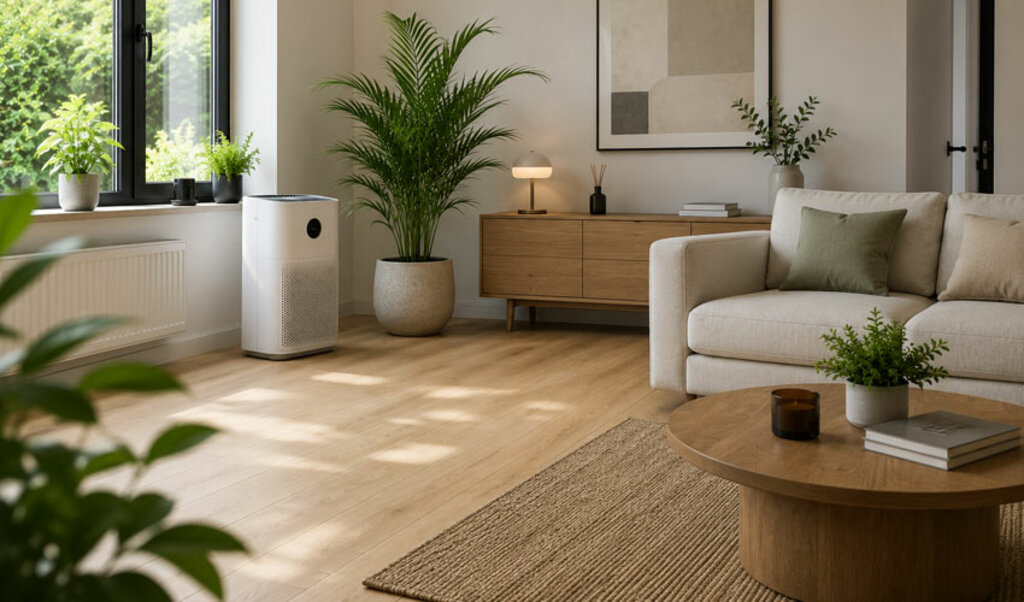
Indoor air quality affects how a home feels day to day far more than most people think about — dust, allergens, and the products we use to clean and finish surfaces all play a part. A few practical, evidence-based changes make a genuine difference, and your flooring choices are a bigger factor in this than most people realise.
Choose Low-VOC Cleaning and Finishing Products
Many conventional cleaning products release volatile organic compounds (VOCs) into indoor air, which can contribute to respiratory irritation and indoor air pollution over time. Switching to genuinely low-VOC, fragrance-free cleaning products — for wood floors specifically, a pH-appropriate cleaner matched to your floor's finish, such as Bona Wood Floor Cleaner for lacquer or Osmo Wash & Care for oiled floors — reduces this without compromising on actually cleaning the floor properly.
This applies just as much to the products used when a floor is finished or refreshed in the first place. Modern water-based lacquers and hardwax oils have significantly lower VOC content than older solvent-based products, and this matters most in occupied homes where the finishing work happens around people actually living there. If you're planning a refinishing project, asking specifically about the VOC content of the products being used is a reasonable and increasingly common question to raise.
Maintain Your Ventilation Systems
If you have an HVAC system, extractor fans, or a standard vacuum cleaner, all three genuinely affect air quality when their filters are neglected. A vacuum with a clogged filter recirculates dust rather than removing it. Extractor fans in kitchens and bathrooms need clearing of built-up grease and dust to work effectively. Checking and changing filters on a regular schedule — rather than only when something obviously stops working — keeps these systems doing their actual job of removing dust, dirt and allergens from the air rather than just moving them around.
Houseplants: A Modest but Real Contribution
Houseplants do measurably improve indoor air in small, specific ways — NASA's well-known Clean Air Study found certain plants capable of removing some volatile compounds from sealed test chambers, though the effect in a normal, ventilated room is considerably smaller than in those lab conditions. Plants are a pleasant addition to a home and a reasonable small contributor to air quality, but they're not a substitute for proper ventilation, cleaning, and low-emission product choices.
Why Wood Flooring Genuinely Helps
This is where flooring choice makes a real, measurable difference. Unlike carpet, a hard wood floor doesn't trap dust, dander, and allergens within a fibrous pile — there's simply nowhere for them to accumulate below the surface. Dust and allergens that land on a wood floor stay on the surface, where regular sweeping, dry mopping or vacuuming actually removes them, rather than settling deep into carpet fibres where a standard vacuum struggles to reach it fully.
This is one of the genuine reasons wood flooring is often recommended for households managing allergies or asthma — it's not a marketing claim, it's a straightforward consequence of having a smooth, cleanable surface instead of a fibrous one. Keeping that advantage means regular cleaning with the right product for your floor's finish, since dust and grit left to accumulate reduces the benefit — and using a low-VOC finish and cleaner, as covered above, means the floor itself isn't adding to indoor air pollutants while you're benefiting from its dust-shedding surface.
A Few Habits Worth Adopting Together
- Ventilate regularly, even briefly — opening windows for a short period daily makes a meaningful difference to indoor air turnover
- Choose fragrance-free, low-VOC cleaning products, particularly for surfaces cleaned frequently like floors
- Keep vacuum and extractor filters clean and replace them on a proper schedule, not just when performance visibly drops
- Sweep or dry-mop hard floors regularly rather than relying on an occasional deep clean alone
- If refinishing a wood floor in an occupied home, ask about the VOC content of the products being used
Common Questions About Indoor Air Quality and Wood Floors
Do wood floors really improve indoor air quality compared to carpet?
Yes, in a real and straightforward sense — a smooth wood surface doesn't trap dust and allergens the way carpet fibres do, so what lands on the floor stays accessible to regular cleaning rather than settling deep into a pile.
Are low-VOC wood floor finishes actually less polluting than standard ones?
Yes — modern water-based lacquers and hardwax oils have meaningfully lower VOC emissions than older solvent-based products, which matters both during application and for ongoing indoor air quality afterwards.
Do houseplants make a meaningful difference to indoor air quality?
Some plants can remove small amounts of certain airborne compounds, based on lab research, though the effect in an actual ventilated room is much smaller than in sealed test conditions. They're a nice addition but not a substitute for ventilation and proper cleaning.